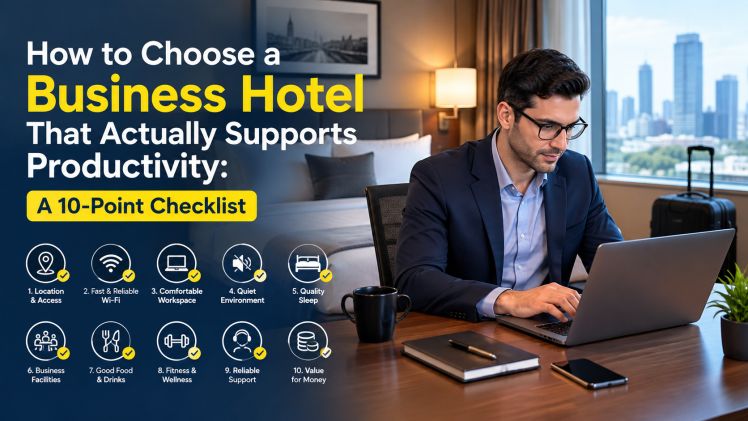
Anyone who travels for work regularly knows the difference between a hotel you sleep in and a hotel you can actually work in. The first kind has a bed, a TV, and a Wi-Fi password you have to ask for twice. The second kind quietly supports everything you need to get done between meetings, and it can make or break a business trip.
The problem is that most booking sites treat every property the same. A search for a business travel hotel returns hundreds of options, all with similar photos of lobbies and breakfast buffets, and very little information about the things that matter when your trip has a purpose beyond sightseeing. So you end up rolling the dice, and sometimes you lose. You lose an afternoon because the internet dropped during a client call. You lose sleep because the room faces the highway. You lose a deal because the “meeting room” turned out to a corner of the restaurant with a folding table in it.
After a few years of trial and error, most frequent travelers develop their own informal criteria. Here is mine, written down as a ten point checklist you can run through before you book your next trip.
1. Test the Wi-Fi before you commit, not after
Internet quality is the single most important amenity for a working trip, and it is also the hardest to verify in advance. Look for hotels that mention fiber or high speed connectivity in their listing, and read recent reviews with the word “wifi” in them. A property that takes its connectivity seriously will usually say so, because they know it is a selling point. If the listing says “Wi-Fi available” with no detail, that is often a polite way of saying it exists but is not something they want to discuss.
2. Look at the desk situation, literally
Open the room photos and find the desk. Is there one? Is it a real desk with a chair, or is it a decorative ledge next to the window with a stool? A proper workspace means a desk deep enough for a laptop and a notebook, a chair you can sit in for three hours, and outlets within arm’s reach. This sounds obvious, but a surprising number of otherwise excellent hotels treat the workspace as an afterthought.
3. Check the power options
Older properties in particular can be stingy with outlets. You want at least two free outlets near the desk, ideally with USB ports, plus something accessible on each side of the bed. If you travel with a laptop, phone, tablet, and a camera battery like I do, outlet scarcity becomes a nightly juggling act. Some hotels now list charging stations or bedside USB as amenities, which is a good sign.
4. Sound is a productivity feature
Sleep is the foundation of everything else on this list. A tired traveler is not a productive one. Look for clues about noise: double glazed windows, rooms away from elevators and ice machines, and a location that is not directly above the hotel bar. Reviews will tell you the truth here. Search for “noise” or “thin walls” and see what comes up. One or two complaints are normal. Twenty are a pattern.
5. Evaluate the meeting space honestly
If you are hosting a client presentation, a small team offsite, or a series of interviews, you need real meeting space. What you are looking for is a room with a door, a table that seats everyone comfortably, a screen or the ability to connect one, and staff who can help with setup. Smaller independent properties often do this better than you would expect, because their meeting rooms are a core part of their business rather than an afterthought bolted onto a ballroom. Ask about capacity, AV equipment, catering options, and whether the space is private.
6. Location is about time, not scenery
A hotel thirty minutes from your meetings is not a bargain if you spend ninety minutes a day in traffic or rides hares. Map your commitments first, then draw a radius around them. Being walk able to your meeting sites, or at least close to a direct transit line, buys back hours of your day. It also gives you flexibility when a meeting runs long and the next one starts in twenty minutes.
7. Food that fits a working schedule
You will not always have time for a sit down dinner. A hotel with a restaurant that serves early and late, a solid room service menu, or at minimum a honest grab and go option keeps you fed without derailing your calendar. Check the hours, not just the menu. A beautiful restaurant that closes at 8 pm does not help on a night when your call ends at 8:15.
8. Service that anticipates instead of reacts
This one is harder to quantify, but you know it when you experience it. It is the front desk that offers a late checkout when they see your 4 pm flight. The coffee that appears before your early meeting without you asking. The staff who remember your name on day two. Smaller hotels tend to shine here because the same team sees you throughout your stay, and they have the flexibility to solve problems without consulting a corporate manual. Read reviews for phrases like “went out of their way” and “accommodated.”
9. A place to decompress that is not your bed
Productivity is not only about working. It is about recovering well enough to work again tomorrow. A hotel with a comfortable lobby, a quiet outdoor space, a small gym, or a neighborhood worth walking through gives you somewhere to reset between commitments. This is where properties with genuine local character have a real advantage over interchangeable boxes. A twenty minute walk somewhere interesting can clear your head better than an hour of scrolling in bed.
10. Booking terms that respect that plans change
Business travel is unpredictable. Flights get cancelled, meetings get moved, trips get extended. Look for flexible cancellation, easy date changes, and a straightforward process for extending a stay. A hotel that makes it painful to adjust your reservation is adding friction to an already stressful situation. This is worth checking before you book, not when you are standing in an airport at midnight trying to rebook everything.
A quick word on boutique properties
Running through this checklist, you may notice that a lot of it favors smaller, independent hotels over big chains. That is not an accident. Chains win on consistency and points programs. But the things on this list, real meeting spaces, attentive service, quiet rooms, a location chosen for character rather than highway access, are often strengths of boutique properties. Many of them host corporate meetings and small events regularly, and they treat that business seriously because it matters to them.
The best approach is to evaluate each property on its own merits against your actual needs. Print this checklist, or keep it in your notes app, and run through it the next time a work trip comes up. Ten minutes of research before booking saves you from discovering at 11 pm, in a room with one outlet and a desk the size of a cutting board, that you chose wrong.
Travel well, and get some work done.